

Lot n° 191
Estimation :
1800 - 2200
EUR
Result without fees
Result
: 5 300EUR
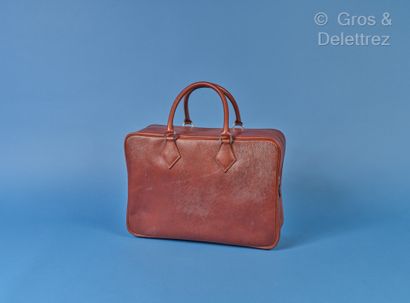
HERMES Paris made in France year 2018 - "Plume" bag 40cm in - Lot 191
HERMES Paris made in France year 2018 - "Plume" bag 40cm in Volynka terracotta Russian leather, zipper, double handle. Very good condition (slight traces). Bibliography: "La Renaissance d'un cuir Impérial. Its name invites us to dream and travel. Long lost, the secret of its tanning has been rediscovered: baptized Volynka, Russian leather is reborn in the new leather goods collection. The origins of Cuir de Russie - In Paris in the 1920s, it was the aroma that was all the rage. White Russians, fleeing a world that was no longer theirs, cherished it as a vestige of their grandeur. Various fragrances, more or less virile, are sold under this name, as Russian leather delights perfumers; yet it was originally the warrior leather of soldiers' boots. According to legend, youfte - another of its names - was born when a Cossack rubbed his boots against birch bark to waterproof them. The leather's resistance to water and its robustness made its reputation. It is, of course, the timeless leather of bindings and coach interiors. Solid yet soft in the hand, this material flatters the senses. A leather that, as art historian Sophie Mouquin points out, "distills a blend of lapasang souchong, cigar and peated whisky: a unique scent that is its signature". In the 18th century, Russian leather was one of the jewels in the crown of the Russian Empire's trade with the West, for which the first choice of tanned hides was destined until the beginning of the last century. Imperial Leather gets a new lease of life - It was across the Channel in the early 70s that Russian leather was resurrected. In England, divers brought to the surface the precious cargo of a two-masted ship that had sunk in 1786 off the coast of Plymouth. The Metta Catharina left St. Petersburg after a storm, and the Russian hemp and leather in its holds never reached Genoa. For two centuries, the sea jealously preserved the beautiful leather rolls buried in the protective mud, confirming the rot-proof nature of this unique material. Twenty years later, in the 90s, Hermès acquired a dozen of these mythical skins. They were fashioned into the Sac à dépêches and Kelly, today entrusted to the Conservatoire des créations Hermès in Pantin. But the House wants to go further: in 2011, a working group is created. The idea is to unearth the secrets of this diamond-grained leather, most often calfskin, traditionally dyed red, hardened and impregnated with a powerful-smelling oil. The investigative work lasted six years, with the stubborn complicity of perfectionist craftsmen. Since Roman times, in a tannery nestled in the heart of the English countryside, the gestures haven't changed: oak bark is ground in wheelbarrows; hides are dehaired by hand, one by one, on an ageless easel. Raw, salt-soaked hides are first immersed in a lime and clear water bath. Before being dried, split, fed and finished, the hides are soaked four or five times in a pit, in a skilful solution of tree bark - vegetable tannins. The secret of good tanning is "a bit like making a good cup of tea", jokes the owner. Here, tanning is a praise of slowness, just like the maturing of a fine wine. In fact, "tanners rely heavily on their noses". Thanks to this chain of enthusiasts, it has been possible to unlock manufacturing secrets, such as the mysterious oil of birch and other plant essences, which fortifies the flower and hardens its surface. Volynka calfskin is now available for three luggage items (Bolide voyage, Haut à Courroies, Plume voyage) and one Ulysse notebook cover. Talismans with a fragrance both smoky and woody, powerful and incomparable." Maison Hermès.
My orders
Sale information
Sales conditions
Return to catalogue